
How to Check a Hale County Case
Go first to the court named on the citation, bond paper, or case notice. A felony in Hale County usually lands with the District Clerk and one of the district courts. Misdemeanor and county-level matters may sit with the County Clerk instead. Traffic tickets and Class C cases can name JP1, JP3, or a municipal court. Lost the paperwork? Gather the full name on the case, the approximate filing year, date of birth if the office asks, and any citation or cause number you can find.
- Read the issuing court and jurisdiction on the notice.
- Use the matching clerk or court contact listed on the relevant page.
- Check the Hale County Sheriff's Active Warrant List as a separate lead.
- Ask the office whether it can confirm an active entry, a recall, or a new setting.
- Follow only the court's current payment, appearance, or records-request instructions.
Keep questions tight when you call a Hale County office. Ask which case number applies, what public record exists, and whether a later action has been entered. A web result never changes a court order.
County Offices Do Different Work
The Hale County website sorts its courts, clerks, Sheriff, and constables into separate office sections. That navigation is a helpful map, not a shared warrant database. The District Clerk holds files for the 64th and 242nd District Courts, while the County Clerk keeps the County Court record. JP1 and JP3 each handle lower-level matters inside their own precincts, and every city municipal court runs its own citation calendar. A directory entry still tells you nothing about whether a particular warrant is active, so start with the named court and go to the Sheriff for its list or service questions. If an office redirects you in Hale County, get the receiving court's full name and case number so your next request lands with the right record holder. The county's office navigation page shows which departments exist and where each one sits.
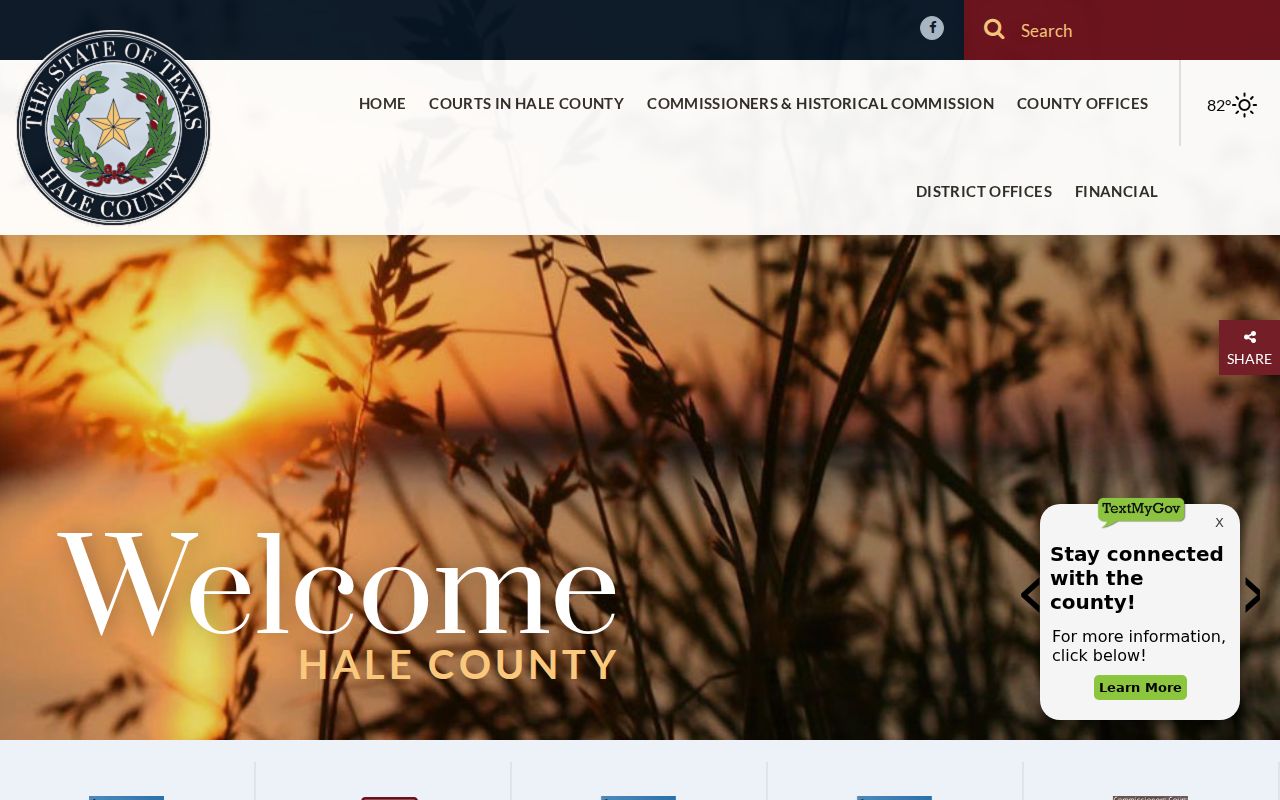
The Hale County directory maps the office routes; it shows no current case result. Confirm contact details before you visit.
What the Sheriff's Active List Can Tell You
The Hale County Sheriff's Office posts an Active Warrant List from its county page, hosted on a separate sheriff page. The Sheriff does not state the list's search fields, update schedule, or inclusion rules, so treat any visible result as a reason to call the Sheriff or the issuing court rather than a final word. The list also stands apart from records held by district, county, JP, or city courts. A missing name does not prove no court process exists, and an old entry may lag behind a payment, appearance, or recall. Reach the Sheriff at (806) 296-2724 and the jail at (806) 293-5377, 1900 S Columbia in Plainview. The office posts no separate warrant desk or warrant-specific hours. The Hale County Active Warrant List page is the county's link to that sheriff-hosted list.
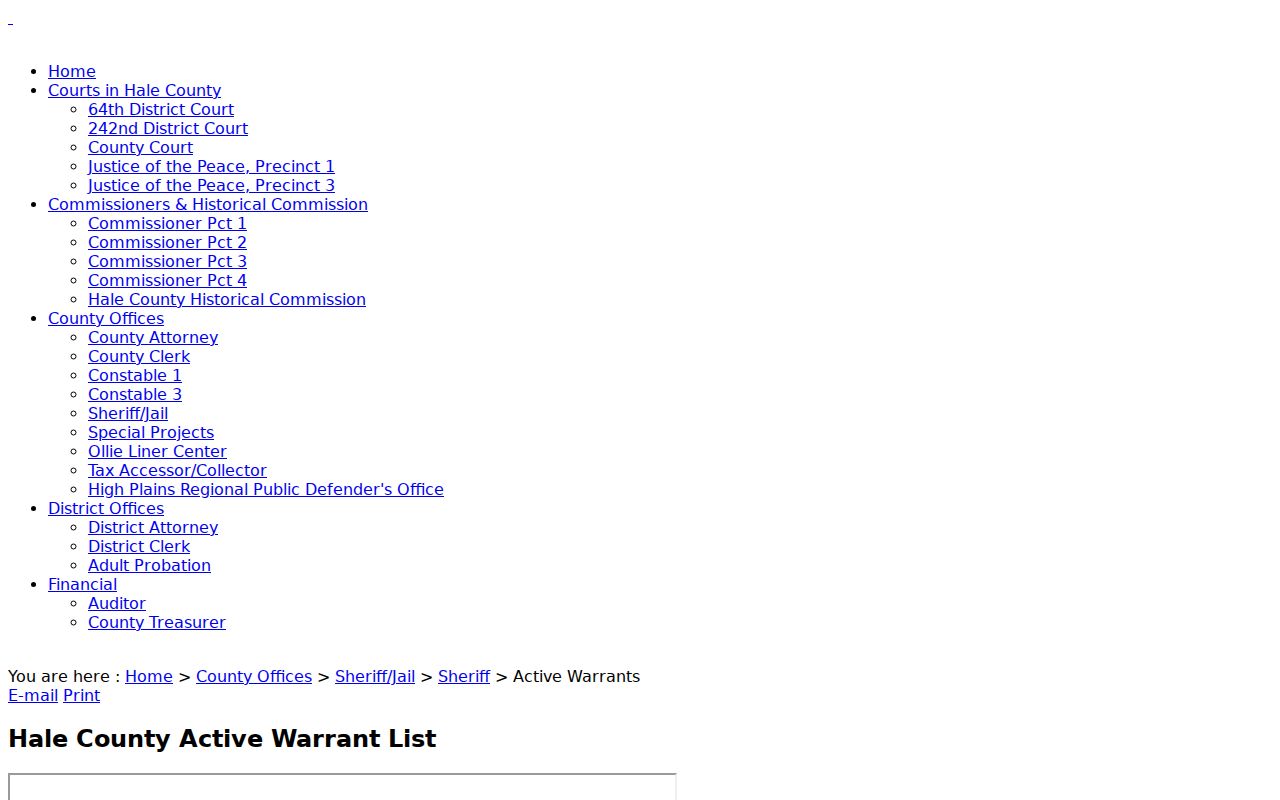
The Hale County page links the warrant list; it says nothing about how often entries change. Call the Sheriff for its current process.
District and County Court Records
Hale County's 64th and 242nd District Courts hear felony cases and other district matters. District Clerk Julie Kelly keeps those records at 225 Broadway, Suite 4, Plainview, phone (806) 291-5226. County Clerk Christine Reyna holds the County Court file at 500 Broadway, Room 140, reachable at (806) 291-5261. Either clerk can identify the court file and explain how to get public access to a particular case. Remember that a clerk's file and the Sheriff's active list are not interchangeable. Ask the clerk whether an executed warrant, return, or later order appears in the case record, and bring the approximate date and cause number when you can. The office can also separate a public docket item from a document that is restricted or simply not kept in that form. The District Clerk office page lists the office's role and contact route.
The Hale County directory names each clerk's role and office route. Confirm current hours with the clerk.
Justice Courts and City Citations
Hale County lists two justice courts, JP1 and JP3, both handling Class C and traffic cases. JP1 sits at 500 Broadway, Suite 10, Plainview, phone (806) 291-5201. JP3 sits near I-27 and FM 54 by Abernathy, phone (806) 757-2476. Your citation should name the precinct that issued it, and never assume an online result from one court covers the other precinct or a municipal case. Plainview, Abernathy, Hale Center, and Petersburg each document their own municipal-court routes: Plainview offers a citation search, Abernathy publishes a court contact period, Hale Center material stays mostly directory and aggregate-report information, and Petersburg describes a posted docket schedule. One wrinkle worth knowing: county pages list JP1 and JP3, while some Petersburg material refers to JP2. Let the issuing court named on the citation decide where your question goes, and confirm jurisdiction with that court in Hale County.
Plainview's Separate Citation Search
Plainview runs its own municipal-court search form, and it covers only city citations. The Hale County towns around it have their own courts, so don't lean on this tool for JP, district, or neighboring-city matters. The form works through several combinations: citation number with date of birth, driver's license and state with date of birth, name with date of birth, vehicle plate and state, Social Security number with date of birth, or business name. Every one of those fields points to a citation lookup. None of them makes it a countywide warrant index for Hale County. Read the court name printed on the ticket before you type in any personal information. That detail tells you which office truly holds the case. A hit on the lookup is a start, not a finish; call the Municipal Court and ask about the current procedural status. A miss can mean a field was entered wrong, the case sits in a different court, or the interface simply does not surface that record. Check with the clerk before concluding no case exists. One more rule of thumb for Hale County: use a city form only for that city's citations, since its fields can't confirm a status another court entered.
Public Access Depends on the Record
Texas treats warrant records as public only in spots, not across the board. Article 15.26 of the Code of Criminal Procedure opens an executed warrant and its supporting affidavit to the public once execution happens, subject to applicable restrictions. The Family Code, section 58.010, pulls juvenile warrant information back behind confidentiality. A clerk in Hale County may also draw a line between the public docket and a protected filing, or note that a record is not in the office's custody at all. The Texas Public Information Act, Government Code Chapter 552, covers requests for records held by covered public bodies, though exceptions can shield law-enforcement information. Any request should name the record and the agency holding it. What the Act won't do is force an office to build a new search product or bless a legal conclusion. Keep this separate from a court's case lookup. A Hale County request channel and a docket inquiry are two different doors.
DPS and OmniBase Are Not Warrant Portals
Two state tools get mistaken for warrant portals, and neither is one. The Texas Department of Public Safety's failure-to-appear and failure-to-pay program deals with driver-license renewal compliance. DPS licensing staff do not verify whether a court warrant exists. OmniBase describes the program and may help explain a hold, but it can't replace the court's docket or the Hale County Sheriff's list. A citation can block renewal even when no warrant is currently outstanding. The court also takes up to seven business days to push a citation update through to DPS after processing. That window is an administrative clearing interval. It is not a promise that a warrant has been recalled. Call the issuing court in Hale County about the case, and call DPS about the license. Keep those two questions apart.
Most Wanted and Federal Records Have Separate Scope
The Sheriff's site links to the Texas DPS Top 10 Most Wanted program under its own heading. Hale County has no local most-wanted roster, reward program, tip line, or named roundup of its own. The state list is not the Sheriff's Active Warrant List, and neither one replaces court records. Both are narrow views. The dedicated most-wanted page spells out that boundary. Federal cases run through federal courts and agencies, not the Hale County clerk system. If paperwork names a federal court or agency, take the question there. A local office cannot confirm a federal docket just because the person lives in Hale County.
Ask for the Current Case Entry
Every time you contact an office, write down the date, the employee or desk you reached, the case number, and the exact next step the court identifies. Then pin down what you're really asking about: an active warrant, a payment plan, a missed appearance, an executed warrant return, or a license hold. Those terms name different events. Swap one for another and your request lands at the wrong desk in Hale County. Use the county pages for the Sheriff, the clerk, district-court, traffic, and municipal routes. A notice naming a city sends you to that city's page. A notice naming a JP precinct sends you to that precinct court. A public webpage is a finding aid, nothing more. Only the responsible public office can confirm the current entry or tell you what action it has authority to accept.